

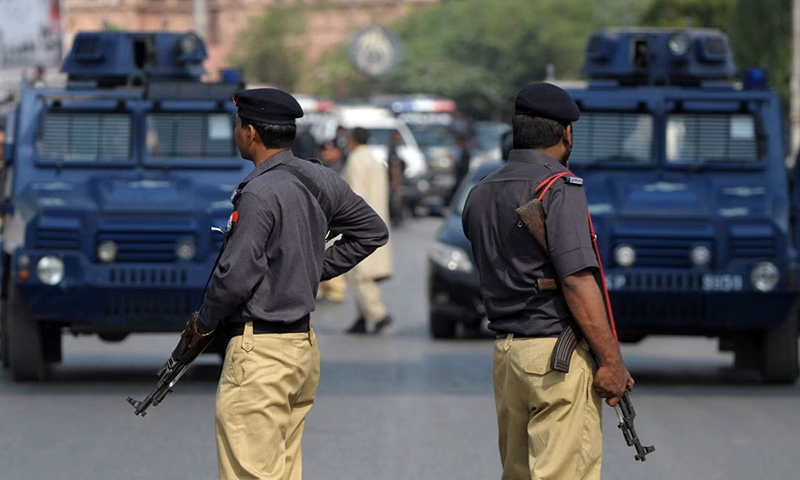
KARACHI: Police on Wednesday launched a major Karachi Sohrab Goth operation to demolish hundreds of houses vacated by Afghan nationals in the Afghan Camp area, a move authorities say is aimed at preventing illegal occupation by land grabbers and rogue elements.
Officials said the land, owned by the Malir Development Authority (MDA), comprises 3,117 houses spread across approximately 200 acres. Among them are 200 to 250 houses belonging to Pakistani families, while the rest were built to accommodate Afghan refugees during their stay in the city.
According to police data, around 15,680 Afghan nationals had previously resided in the Afghan Camp. Of these, 14,296 individuals have already returned to Afghanistan, while 1,384 remain and are being repatriated in phases under the government’s repatriation policy.
West Zone Deputy Inspector General (DIG) Irfan Ali Baloch, who is supervising the Karachi Sohrab Goth operation, told Dawn.com that the operation was being carried out to safeguard the vacated land from being illegally occupied.
“The government-owned land was spread over 200 acres, with 3,000 houses built to accommodate Afghans,” DIG Baloch said.
“We have taken this step to ensure that no rogue elements or land mafia groups take advantage of the vacated area.”
DIG Baloch also said he had written to police authorities requesting the formation of a special committee comprising representatives from the city administration, police, and other relevant agencies to prevent the illegal reoccupation of the cleared plots.
He described the Afghan Camp as “the largest settlement of displaced Afghans” in Karachi, where an estimated 30,000 Afghans once lived. “They were repatriated to their home country in three phases as per the federal government’s policy. However, around 2,000 Afghans are still residing there,” he said.
The Karachi Sohrab Goth operation began early Wednesday morning, with heavy machinery deployed to tear down unauthorized structures. According to DIG Baloch, demolition work on structures covering about 20 acres was completed during the first phase.
“The operation will continue for the next three to four days,” he confirmed, adding that police had coordinated with the Karachi commissioner and MDA officials to ensure the process remained orderly and secure.
Background of the Repatriation Policy
The government’s ongoing action follows the October 2023 ultimatum issued to all undocumented immigrants to leave Pakistan voluntarily or face deportation. The directive, which particularly affected Afghan nationals, marked the start of a nationwide crackdown against illegal foreign residents.
By November 2023, authorities launched a full-scale operation to deport undocumented Afghans, initiating the largest repatriation campaign in recent years. The move came after the expiry of the deadline given for voluntary departure, prompting police and district administrations to assist in the process.
In March 2024, the Pakistani government began preparations for the second phase of the repatriation drive, which aimed to return nearly one million documented Afghan refugees as well. Provincial authorities were instructed to map Afghan settlements, collect data, and coordinate logistics for deportation in a systematic manner.
As part of the policy, March 31, 2025, was officially declared the final deadline for Afghan Citizen Card (ACC) holders to leave the country voluntarily. The interior ministry reiterated that mass deportations would follow if refugees failed to comply with the directive.
Purpose of the Karachi Sohrab Goth Operation
Officials involved in the Karachi Sohrab Goth operation said that once the Afghan residents vacated their homes, the vacant land became vulnerable to encroachment. Law enforcement agencies, acting on intelligence reports, decided to move swiftly to prevent illegal construction or land-grabbing attempts.
DIG Baloch emphasized that the operation was preventive in nature and part of a broader government initiative to maintain law and order in areas that were previously densely populated by undocumented migrants. He added that security personnel were deployed in large numbers to ensure smooth execution and to avoid potential clashes.
“Our aim is to protect government property from encroachment. This operation is being conducted with complete transparency and coordination with civil authorities,” he said.
Future Steps and Oversight
Officials have confirmed that after the demolition phase, the land will be handed back to the Malir Development Authority, which will determine its future use. Authorities are also considering deploying surveillance units to monitor the area and ensure that no illegal construction takes place again.The Karachi Sohrab Goth operation marks one of the most significant post-repatriation clean-up initiatives in Karachi, underscoring the government’s resolve to enforce its immigration and land management policies.